
Quick Answer
Retailers sourcing wholesale sunglasses should confirm UV400 protection, check for ANSI Z80.3 or ISO 12312-1 compliance documentation, and understand the lens filter category system before placing a bulk order. These standards protect customers, reduce liability exposure, and make it easier for staff to answer questions with confidence.
Selling sunglasses wholesale means passing along more than a stylish frame. Every pair a retailer stocks carries an implicit promise that it will protect the wearer's eyes from the sun. Understanding what the standards behind that promise actually mean, and what a supplier should be able to document, protects both the retailer and the end customer. If you have not yet finalized who you are buying from, our guide on how to choose a wholesale sunglasses supplier is a useful starting point before this one.
Why UV Protection Claims Matter for Your Business
Sunglasses that block little to no UV radiation can actually be worse for the eyes than wearing no sunglasses at all. A dark lens causes the pupil to dilate, letting in more light overall, and if that lens is not also blocking UV rays, more UV radiation reaches the eye than would without any lens at all. For a retailer, this is not just a product quality issue. It is a customer trust issue and a liability issue. Being able to confidently answer a customer's question about UV protection, backed by real documentation from your supplier, is part of running a credible sunglasses program.
What UV400 Actually Means
UV400 refers to a lens that blocks essentially all UV radiation up to 400 nanometers in wavelength, which covers both UVA and UVB rays. This is the protection level most eye care professionals recommend. It is worth repeating to staff and customers alike that lens darkness and UV protection are two completely separate properties. A very dark lens with no UV coating offers style and glare reduction, but not necessarily eye protection. A lighter lens with a genuine UV400 rating can outperform it where it actually counts.
ANSI Z80.3: The US Standard Buyers Should Know
ANSI Z80.3 is the American National Standards Institute standard covering nonprescription sunglasses sold in the United States. It sets requirements around UV transmittance and basic optical quality. When evaluating a new supplier or a new product line, it is reasonable to ask whether the sunglasses meet ANSI Z80.3 and whether the supplier can provide a certificate of compliance or a lab test report. A supplier who cannot answer this clearly is worth a second look before you place a large order.
CE Marking and ISO 12312-1 for International Sourcing
Many sunglasses sold globally, including styles that started out built for European distribution, reference ISO 12312-1, the international standard for general use sunglasses. In the European Union, compliant sunglasses carry a CE mark confirming they meet personal protective equipment requirements, which includes the ISO 12312-1 lens category and UV protection rules. Even for buyers who only sell in the United States, understanding this standard is useful, since it is the source of the lens filter category system described below.
Standard | Where It Applies | What It Verifies | What to Ask a Supplier |
ANSI Z80.3 | United States | UV transmittance limits and basic optical requirements for nonprescription sunglasses | Ask for a certificate of compliance or test report referencing ANSI Z80.3 |
ISO 12312-1 | International, referenced widely including the EU | Lens filter category (0 to 4) and UV protection requirements | Ask which filter category each style falls into and whether it is lab tested |
CE Marking | European Union | Overall compliance with EU personal protective equipment requirements, including ISO 12312-1 | Ask to see the CE documentation if sourcing styles originally built for EU distribution |
Lens Filter Categories Explained
Sunglasses are often labeled with a filter category from 0 to 4 under ISO 12312-1. This number describes how much visible light the lens allows through, known as visible light transmittance, and it has nothing to do with UV protection on its own. A lens can be any filter category and still fail to block UV rays if it was not built with a UV coating or UV absorbing material. The chart and table below break down what each category means in practical terms.
Category | Light Transmittance | Typical Use |
0 | 80% to 100% | Very light or clear lenses, fashion or indoor use, minimal glare protection |
1 | 43% to 80% | Light tint, suited to overcast days or low glare conditions |
2 | 18% to 43% | Medium tint, the most common choice for everyday general purpose sunglasses |
3 | 8% to 18% | Dark tint, suited to strong sun, beach, and driving conditions |
4 | 3% to 8% | Very dark tint for extreme glare, not suitable for driving |
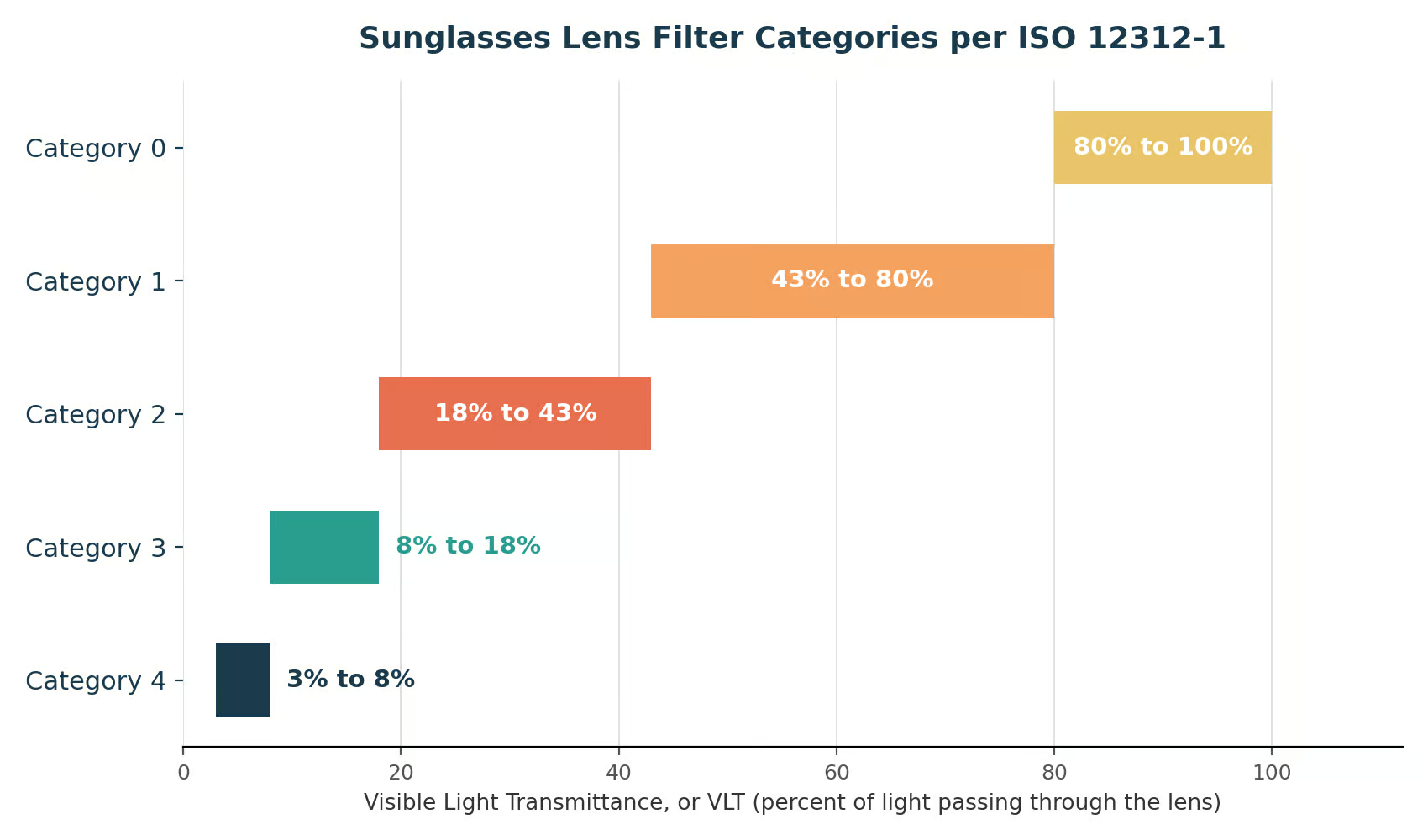
Category 2 and Category 3 lenses cover the bulk of everyday sunglasses demand, which pairs naturally with a conversation about lens type. For a deeper look at how polarization fits into this picture, see our post on polarized versus non-polarized lenses.
Four Questions to Ask Any Sunglasses Supplier
Before placing a wholesale order, it is worth confirming the following directly with your supplier. Does this style carry full UV400 protection. Does the product meet ANSI Z80.3 or ISO 12312-1. What filter category applies to each lens tint offered. Can documentation be provided if a customer or an inspector ever asks for it. A supplier who answers these questions quickly and clearly is signaling that quality control is part of how they operate, not an afterthought.
Documentation That Protects Your Business
Keeping supplier compliance documentation on file, even informally, gives a retailer a paper trail if a product question or complaint ever comes up. This does not need to be complicated. A simple folder of compliance statements or test reports organized by supplier and product line is enough for most independent retailers and boutiques. It also makes onboarding new sales staff easier, since they can point to real documentation instead of guessing when a customer asks how much protection a pair of sunglasses actually provides.
Frequently Asked Questions
Does a darker lens mean better UV protection?
No. Lens darkness and UV protection are separate properties. A dark lens without a UV coating can let in more UV radiation than no sunglasses at all, because the pupil dilates in response to the reduced light. Always confirm UV400 protection separately from lens tint.
What filter category should a general purpose sunglasses line focus on?
Category 2 and Category 3 lenses cover the majority of everyday sunglasses demand, since they offer meaningful glare reduction while remaining suitable for regular daytime wear and driving.
Is ANSI Z80.3 required by law for sunglasses sold in the United States?
ANSI standards are voluntary rather than mandatory by federal law in most cases, but they represent the recognized benchmark for sunglasses quality in the US market, and many retailers and buyers treat compliance as a baseline expectation.
How can a retailer verify a supplier's UV protection claims?
Ask directly for a certificate of compliance or lab test report referencing ANSI Z80.3 or ISO 12312-1. A supplier with a genuine quality control process should be able to provide this without difficulty.
Have questions about UV protection or documentation on any of our sunglasses lines? Contact West Coast Sunglasses at 727-530-9260 and our team can walk you through what is available.



 No products in the cart.