Sunglasses with built-in audio are no longer a novelty item at a handful of specialty shops. Open ear speakers, Bluetooth connectivity, and sun protection are now packaged into a single frame, and the category is showing up in general retail, not just electronics stores. For wholesale buyers who have not looked at it yet, smart sunglasses are worth a closer look, with a testing approach rather than a full assortment commitment.
| Quick Answer
Smart sunglasses pair Bluetooth audio speakers with a standard sunglass frame, letting a customer listen to music or take calls without earbuds while still getting UV protection. They sit at a higher price point than standard sunglasses and appeal to a different type of shopper, so the safest way to add the category is a small test order in a visible spot, not a full shelf reset. |
What Smart Sunglasses Actually Are
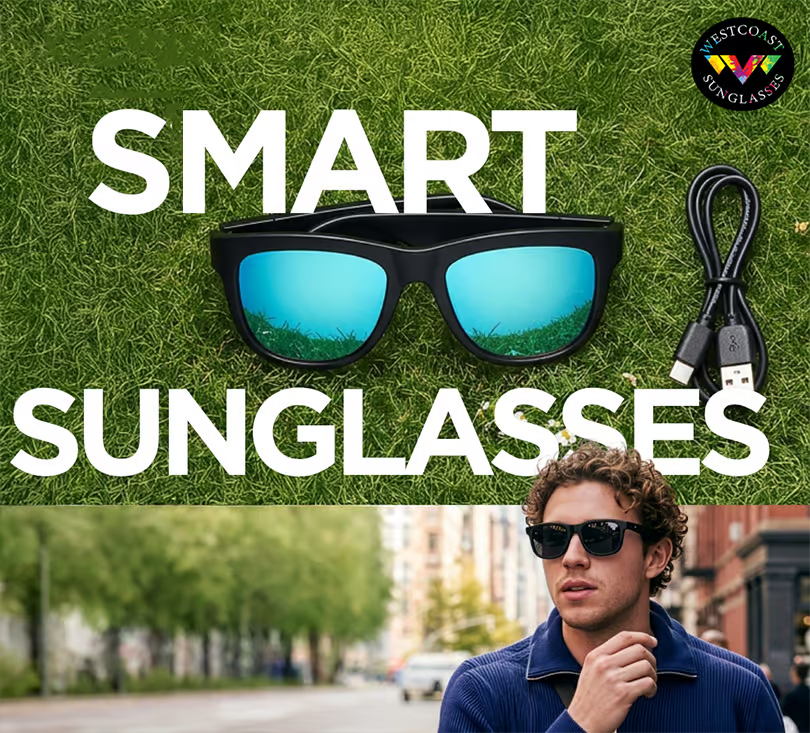
Most smart sunglasses use open ear or bone conduction style speakers built into the temple arms, paired to a phone over Bluetooth. The lenses still need to meet the same UV protection standard as any other pair, so this is not a tradeoff between tech features and eye protection. A rechargeable battery and a charging case or cable round out the basic package.
Who Actually Buys Them
- Commuters and cyclists who want audio without blocking outside noise or covering their ears.
- Runners and gym goers who already buy performance-oriented sunglasses and gear.
- Tech-forward gift shoppers looking for something that feels new, particularly around the holidays.
- Younger shoppers who are used to audio wearables and see this as a natural next accessory.
A Phased Way to Test the Category
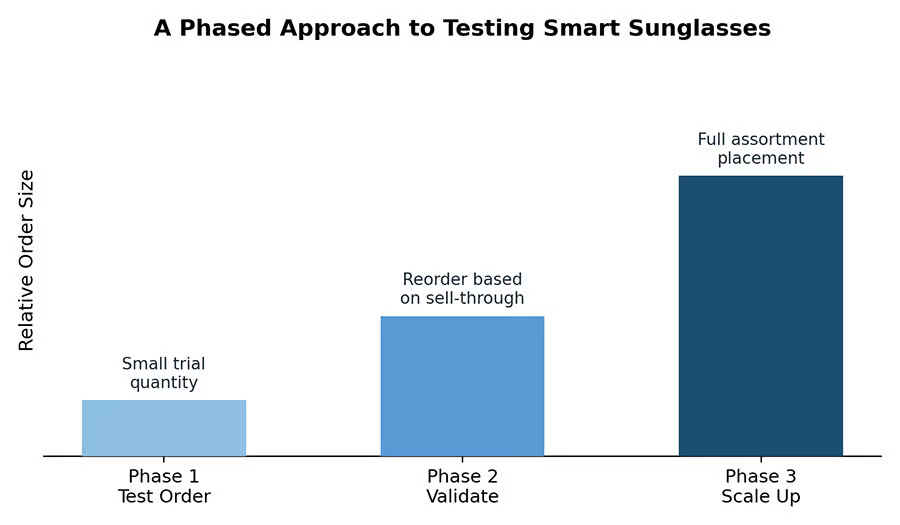
Because smart sunglasses cost more than a standard pair and appeal to a narrower shopper, it makes sense to treat this as a test category rather than ordering it at the same depth as your core assortment. Start small, watch how it performs, and scale the order once you have real sell-through data from your own store.

A small test order also limits your exposure while you learn how customers respond to a feature-based sunglasses category, which behaves differently from a purely fashion or performance driven style.
This is the same cautious approach we recommended for another newer category in our article on
RX prescription swim goggles as a wholesale category, where a small first order let retailers gauge demand before committing shelf space.
Where to Place Them in Store
Smart sunglasses do not fit neatly into a standard sunglasses display because the buying decision is different. A shopper choosing a $12 pair of fashion sunglasses is not usually comparing it to a smart pair. Give the category its own small fixture or a clearly labeled shelf tag, ideally near electronics accessories or at a counter where a staff member can explain the audio feature and offer a quick demo.
For general display principles that still apply here, see
how to build a sunglasses display that actually sells.
What to Verify Before Ordering
- Battery life and charging method, since this is the main feature customers will ask about.
- Confirmed UV400 protection on the lenses, the same standard that applies to any pair you stock.
- Frame durability and fit, using the same criteria you would apply to any new style.
- Warranty or defect policy on the electronic component, which is different from a standard frame or lens issue.
Our general checklist in
what makes a sunglass style retail-ready still applies to the frame and lens side of a smart sunglasses order, with the battery and electronics as an added layer of due diligence.
Reference Table: Smart Sunglasses vs. Standard Sunglasses
| Factor |
Standard Sunglasses |
Smart Sunglasses |
| Primary buyer motivation |
Style, sun protection, price |
Audio feature plus sun protection |
| Typical price position |
Entry to mid-range |
Mid to premium |
| Ideal initial order size |
Full assortment depth |
Small test quantity |
| Display approach |
Standard fixture or end cap |
Dedicated shelf tag or demo spot |
| Extra diligence needed |
Frame and lens quality |
Frame, lens, battery, and warranty |
Frequently Asked Questions
Are smart sunglasses just a passing trend?
Audio wearables in general have grown steadily for several years, and sunglasses are a natural extension of that trend for anyone who spends time outdoors. Treating it as a test category rather than a core commitment is a reasonable way to find out how it performs for your specific customer base.
Do smart sunglasses still need to meet UV protection standards?
Yes. The audio feature does not change the lens requirement. Confirm UV400 protection the same way you would for any other pair before adding a style to your order.
How should a retailer price smart sunglasses relative to the rest of the assortment?
They typically sit above your standard fashion and polarized tiers because of the added electronics cost, closer to where a premium frame like Mia Nova would sit, though the buyer motivation is different.
What is the biggest risk in stocking this category?
Overordering before you know whether your customer base responds to it. A small first order limits that risk while still letting you offer the category.
| Curious About Adding Smart Sunglasses?
Call West Coast Sunglasses at 727-530-9260 or toll free at 866-228-3888 to ask about current smart sunglasses options for your next order. |

 A small test order also limits your exposure while you learn how customers respond to a feature-based sunglasses category, which behaves differently from a purely fashion or performance driven style.
This is the same cautious approach we recommended for another newer category in our article on RX prescription swim goggles as a wholesale category, where a small first order let retailers gauge demand before committing shelf space.




 No products in the cart.