| Quick Answers
Which sunglass lens colors sell best at waterfront and resort shops? Smoke or gray lenses are the dependable base, blue and gold mirrors are the impulse sellers, and brown or amber lenses win with guests who snorkel, fish or boat.
Does lens color change UV protection? No. Color controls brightness and contrast. UV protection comes from the lens material and coating, so every color you stock should be labeled UV400 or 100% UV.
Should every pair be polarized? Not every pair, but polarized lenses belong in any shop near water because they cut the glare that bounces off the surface.
How dark should the lenses be? For bright beach and pool settings, filter Category 3 is the workhorse. Category 4 is too dark for driving and should be labeled that way. |
A guest walks into your shop at 10 in the morning, squinting, holding a hand over their eyes. They already know they need sunglasses. What they do not know is which pair, and they will usually decide in under two minutes. In that window, lens color does more of the selling than frame shape, brand or display. It is the first thing a shopper sees on the rack, and it is the thing they notice the second they step back out into the sun.
For shops that sit next to beaches, pools, marinas and dive docks, the stakes on lens color are higher than at an inland mall kiosk. Light is stronger, it comes from more directions, and guests are doing activities where the wrong tint becomes a real annoyance. This guide walks through what each lens color actually does, which ones earn the most shelf space in high glare settings, and how to merchandise them so guests choose quickly and leave happy.
Why Lens Color Matters More at the Water's Edge
Inland, most glare comes from above. At the shoreline, it comes from above and below. Sand, sea foam and water all bounce sunlight back up toward the face, so a guest standing on a pool deck or a boat is getting light from two directions at once. That is why a pair that feels fine in a parking lot can feel weak on a catamaran.
 Reflected UV adds to direct sunlight, which is why waterfront shoppers notice lens performance faster.
This matters for your assortment in two ways. First, guests in these settings feel the difference between lens colors quickly, so they are more likely to pick the right pair if your rack makes the choice easy. Second, a lens that is too light or poorly suited to the activity is the pair most likely to come back with a complaint. Choosing colors with the setting in mind is one of the simplest ways to protect your sell through.
A quick note for staff: color and darkness are not the same as protection. A pale rose lens and a near black lens can both block 100% of UV if they are made properly. We cover the testing side in our guide to
UV protection standards, and it is worth making sure everyone on the floor can explain that difference in one sentence.
The Six Lens Colors That Earn Shelf Space
You do not need twenty tints. Six lens families cover nearly every guest who walks in, from the family heading to the beach to the couple dressing for a sunset dinner.
| Lens color |
What it does |
Best guest match |
Sell it with this line |
| Smoke / gray |
Darkens evenly without shifting colors |
Everyone, especially first time buyers |
"Colors look natural, just less bright." |
| Brown / amber |
Boosts contrast and depth |
Snorkelers, anglers, golfers, boaters |
"Helps you see shapes in the water." |
| Green (G15 style) |
Balanced contrast with true color |
Classic style shoppers, drivers |
"The timeless look, easy on the eyes." |
| Blue mirror |
Reflects bright light, cool look |
Pool, beach and boat guests |
"Made for bright water days." |
| Gold / orange mirror |
Reflects glare, warm bold finish |
Younger guests, photo takers |
"Looks great in every vacation photo." |
| Gradient and fashion tints |
Darker on top, lighter below |
Poolside, dinner, shopping |
"Shade from above, see your menu clearly." |
Smoke and gray: the foundation
Gray lenses reduce brightness without tinting the world, which makes them the easiest recommendation for a guest who does not want to think about it. They pair well with almost any frame color and are the default in most of our
polarized collection. If you are building from scratch, this is the color to stock deepest.
Brown and amber: the activity lens
Warm lenses sharpen contrast, which helps guests read the surface of the water, spot reef shapes from a boat, or track a ball on a bright fairway. Guests heading out on excursions often do not know to ask for this, so a staff member who mentions it earns trust fast.
Mirrors: the impulse sellers
Blue and gold mirrors are the colors that stop people as they walk past. A mirror coating sits on top of the tinted lens and reflects a portion of incoming light before it reaches the eye, which is why they feel comfortable on bright water days. They also look great in photos, and vacation guests are thinking about photos. Our
Hawaiian Island Creations collection is built for the water and is a strong place to look for polarized mirror options.
Gradient and fashion tints: the lifestyle lens
Gradient lenses are darker at the top and lighter at the bottom, which suits pool lounging, shaded patios and evening walks. They are rarely the right pick for a full day on the water, but they are often the second pair a guest buys for the rest of the trip. Our
SOHO women's collection and
Mia Nova premium line carry many of these looks.
Darkness Matters Too: Filter Categories in Plain Language
Lens color tells guests how the world will look. Filter category tells them how dark it will be. Most quality sunglasses are marked with a category from 0 to 4 based on how much visible light the lens lets through. European travelers often look for this marking, so having it on your tags helps them shop with confidence.
| Category |
Light let through |
Where it fits |
Shop note |
| 0 |
80 to 100% |
Indoors, fashion only |
Not a sun lens |
| 1 |
43 to 80% |
Cloudy days, evening |
Light fashion tints |
| 2 |
18 to 43% |
Everyday sun, shade |
Good for gradients |
| 3 |
8 to 18% |
Bright beach, pool, boat |
Your core waterfront lens |
| 4 |
3 to 8% |
Extreme glare, high water |
Not for driving; label it clearly |
For a shop that serves beach and pool guests, Category 3 should make up the large majority of what you carry. It is dark enough for midday sun on the water and still safe for the drive back to the hotel.
A Starting Lens Mix for Waterfront Shops
Every location is a little different, but the mix below is a sensible starting point for a resort, marina or beachfront gift shop. Track what sells for a few weeks, then shift the percentages toward your own winners.
Use this as a baseline, then adjust based on your own sell through.
- Lead with smoke. It is the safest recommendation and the most common reorder.
- Give mirrors prime real estate. Put blue and gold mirrors at eye level near the entrance where passing guests see them first.
- Group activity lenses together. A small "On the Water" section with brown, amber and polarized mirrors helps excursion guests find their pair.
- Keep kids in bright, fun colors. Children choose with their eyes, and parents choose on protection. Our kids collection covers both.
Merchandising Lens Colors So Guests Choose Faster
A rack organized by lens color sells faster than a rack organized by style number. Guests can scan from left to right, see the range, and narrow down in seconds. A few simple habits make a big difference:
- Sort by color family, not by frame. Put all smoke lenses together, then warm lenses, then mirrors, then gradients.
- Add a polarization test card. A small card with a glare image lets guests see polarization work in a second. Our polarized vs. non polarized guide explains how to set one up.
- Use one word tags. Labels like "Water," "Everyday," "Style" and "Kids" do more than long descriptions.
- Place a mirror at the rack. Guests want to see the lens color on their own face before they buy.
- Pair with a retainer. Anyone heading onto a boat should hear about sunglass retainers before they pay.
If space is tight, one of our free
sunglasses display programs can organize by lens family out of the box. For more on how display design drives impulse sales, see
how to build a sunglasses display that actually sells.
Common Lens Color Mistakes to Avoid
| Mistake |
What happens |
Better approach |
| Stocking mostly light fashion tints |
Guests return them after one day on the water |
Keep Category 3 as your core |
| Burying mirrors on low shelves |
Your best impulse color goes unseen |
Mirrors at eye level, near the door |
| No warm lens option |
Excursion guests buy elsewhere or not at all |
Add a small brown and amber section |
| Unlabeled Category 4 lenses |
Guests wear them to drive |
Tag clearly as "not for driving" |
| Mixing colors randomly |
Guests cannot compare, decisions slow |
Sort the rack by color family |
Durability matters too, since lens coatings take a beating from sunscreen and salt. Our article on
stocking durable sunglasses for coastal conditions covers care tips your staff can share at checkout.
Frequently Asked Questions
Do darker lenses block more UV?
No. Darkness and UV protection are separate. A properly made light lens can block 100% of UV, and a dark lens without UV protection can actually be worse because it opens the pupil. Always confirm UV400 or 100% UV on the tag.
Are mirrored lenses always polarized?
No. Mirror is a reflective coating, and polarization is a separate filter. Many styles combine both, but check the product details and tag each pair accurately so staff can answer quickly.
What lens color is best for snorkeling or boat trips?
Brown, amber and copper lenses add contrast that helps guests read the water. Polarized versions of these colors are especially popular with anglers and boaters.
Which lens color is easiest to recommend to an undecided guest?
Smoke or gray. It keeps colors true, suits nearly every frame and works in almost every setting a vacation guest will encounter.
How should we label lens colors for international guests?
Short, simple tags work best. Include the lens color, polarized or not, the filter category number and UV400. Numbers and short codes are understood across languages.
Can kids wear mirrored lenses?
Yes, as long as the lenses carry full UV protection and the frame fits properly. Bright mirrors are often a favorite with younger guests.
Build a Lens Lineup That Fits Your Shop
| Ready to restock for the busy season?
West Coast Sunglasses has helped gift shops, resorts and waterfront retailers build sunglass assortments that sell. Our team can recommend a lens color mix for your location, set you up with a free display, and help you choose from polarized, mirrored and fashion styles in our 2026 catalog.
Call 727-530-9260 (toll free 866-228-3888) or contact our wholesale team to start your order today. |

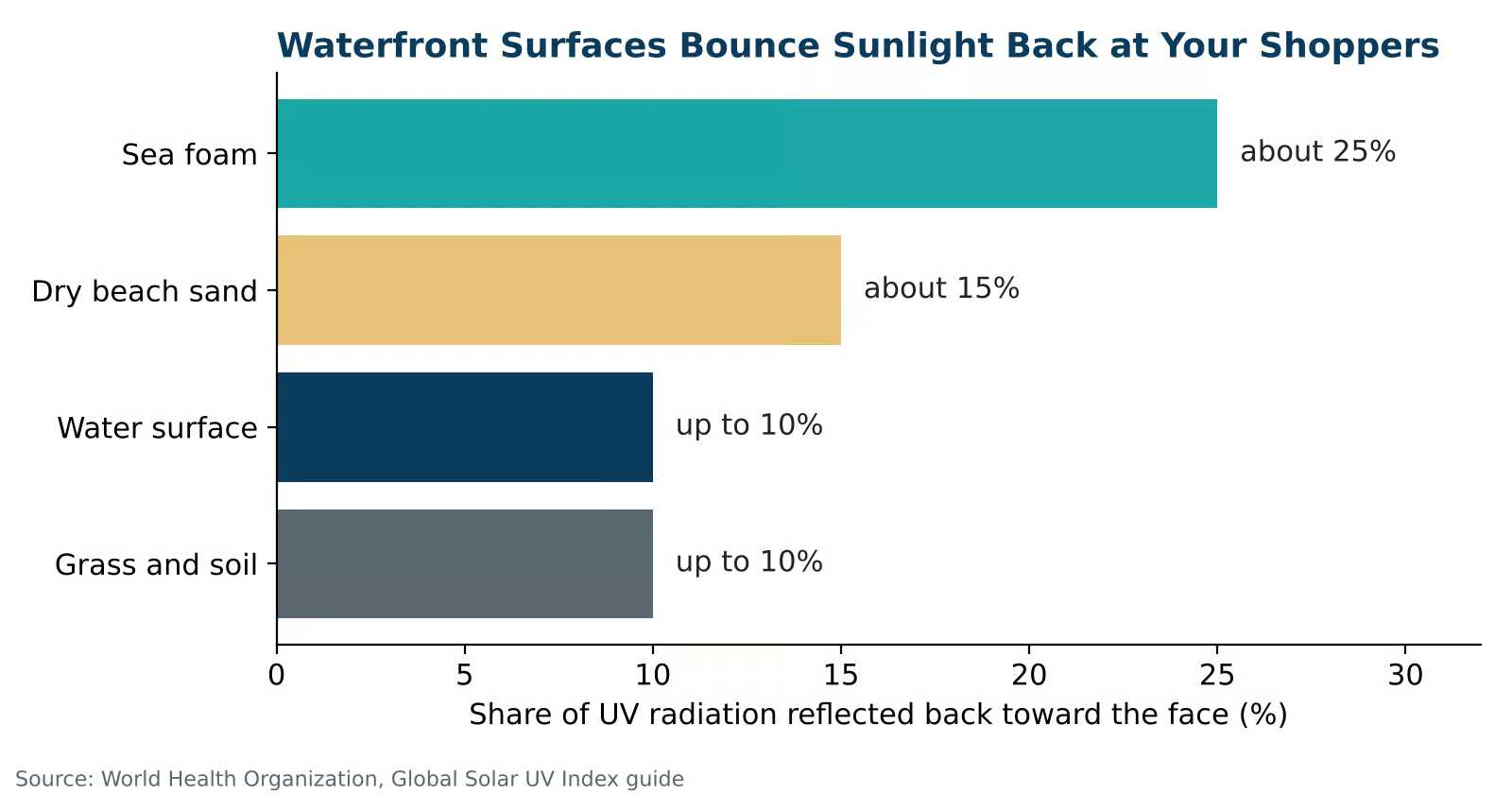 Reflected UV adds to direct sunlight, which is why waterfront shoppers notice lens performance faster.
This matters for your assortment in two ways. First, guests in these settings feel the difference between lens colors quickly, so they are more likely to pick the right pair if your rack makes the choice easy. Second, a lens that is too light or poorly suited to the activity is the pair most likely to come back with a complaint. Choosing colors with the setting in mind is one of the simplest ways to protect your sell through.
A quick note for staff: color and darkness are not the same as protection. A pale rose lens and a near black lens can both block 100% of UV if they are made properly. We cover the testing side in our guide to UV protection standards, and it is worth making sure everyone on the floor can explain that difference in one sentence.
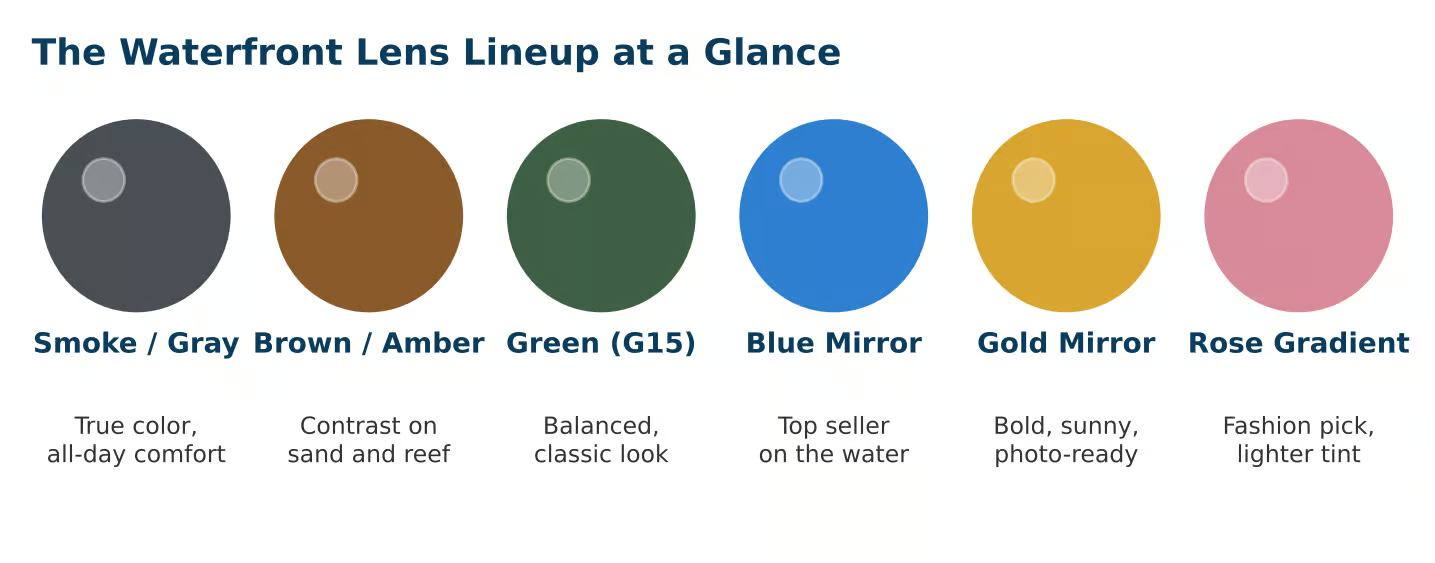 You do not need twenty tints. Six lens families cover nearly every guest who walks in, from the family heading to the beach to the couple dressing for a sunset dinner.
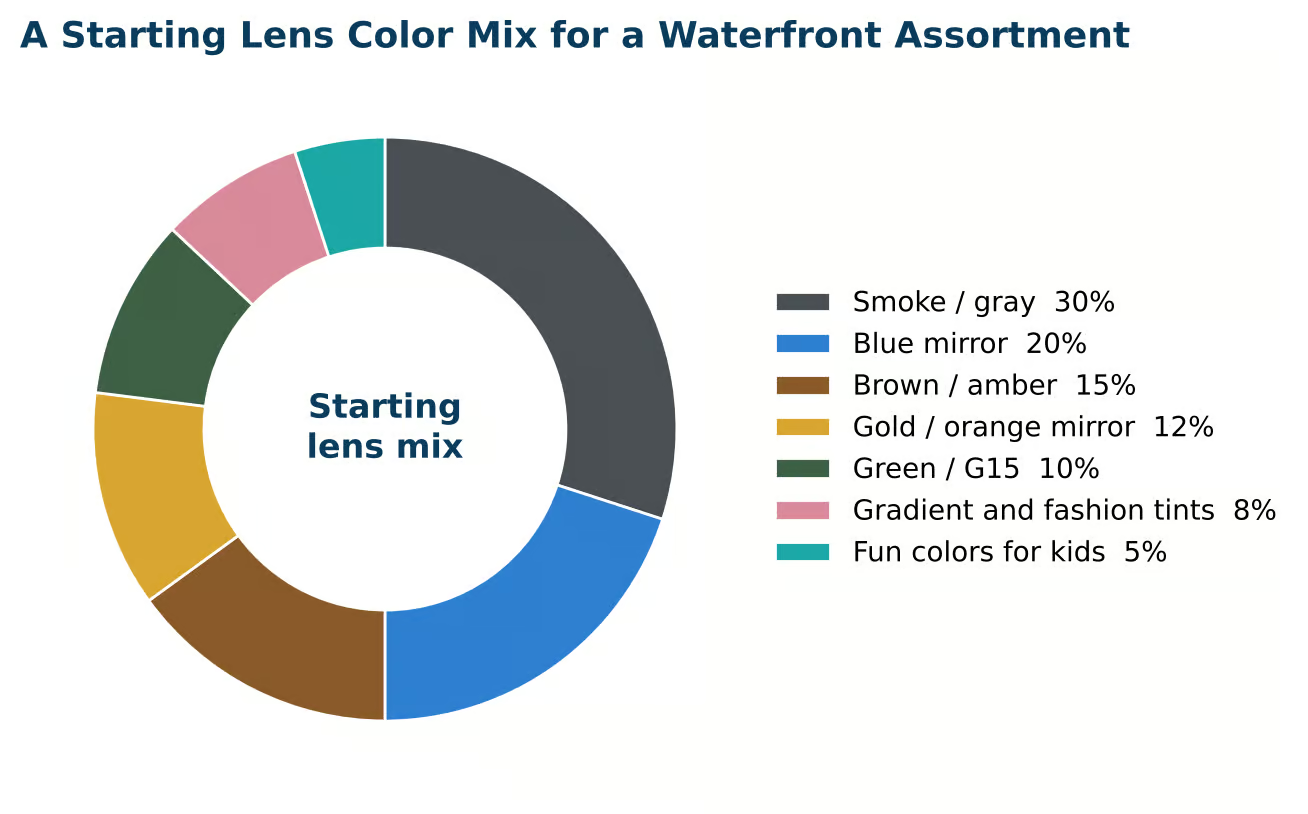 Use this as a baseline, then adjust based on your own sell through.



 No products in the cart.