| Quick Answer
Smart sunglasses sell when shoppers try them, not when they read about them. The retailers who move this category give it a charged demo pair, a 60-second hands-on routine, and three or four short answers staff can repeat to every shopper. Put the demo at the counter, lead with the open-ear audio experience, and close on the same things that sell any pair of sunglasses: fit, lens, and style. With the holiday season ahead, a working demo is the single biggest lever you have. |
Most retailers who add a new category focus on the order: which styles, how many units, where the fixture goes. With smart sunglasses, the order is the easy part. The harder part, and the part that decides whether the category earns its shelf space, is what happens when a shopper picks up a pair and wonders what it does.
We covered the basics of the category, who buys it, and how to place a small test order in our earlier article,
Smart Sunglasses: A New Wholesale Category Worth Testing. This article picks up where that one left off. Your test order has arrived, or it is about to. Here is how to actually sell it on the floor.
Why Smart Sunglasses Are a Demo Category
A shopper can judge a standard pair of sunglasses in seconds. They see the shape, try it on, look in the mirror, and decide. Smart sunglasses carry a feature the shopper cannot see: sound. Until they hear music coming from the temple arms while still hearing the room around them, the product is just a sunglass frame with a slightly thicker arm and a higher price tag.
That is why smart sunglasses behave more like headphones or small electronics than like fashion eyewear. Electronics retailers learned long ago that a product with an invisible feature needs a working demo unit. Sunglass retailers who borrow that lesson tend to see the category perform, and retailers who leave the product boxed on a peg tend to see it sit.
| What the Shopper Asks |
Standard Sunglasses |
Smart Sunglasses |
| How do they look on me? |
Answered by the mirror |
Answered by the mirror |
| Are the lenses good? |
Answered by the tag |
Answered by the tag |
| What does it sound like? |
Not applicable |
Only answered by a demo |
| Can others hear my music? |
Not applicable |
Only answered by a demo |
| How do I control it? |
Not applicable |
Best answered by a demo |
Set Up a Demo Station That Works Every Time
The demo station does not need to be elaborate. It needs to be reliable, because a dead battery or an unpaired pair kills the sale faster than no demo at all.
- One dedicated demo pair. Pull one unit from your order and mark it as the demo. Do not sell it.
- A store phone or tablet already paired. Asking a shopper to pair their own phone adds friction and privacy hesitation. A store device with a short playlist ready to go removes both.
- A charging routine. Charge the demo pair at close each day and add it to your opening checklist.
- Counter placement. Smart sunglasses sell best where a staff member can hand them over. Our guide on how to build a sunglasses display that actually sells covers placement principles, but this category belongs near the register, not on a self-serve spinner at the back.
- A small sign that invites the try. Something as simple as "Try the sound. Ask us." turns a curious glance into a conversation.
The 60-Second Demo
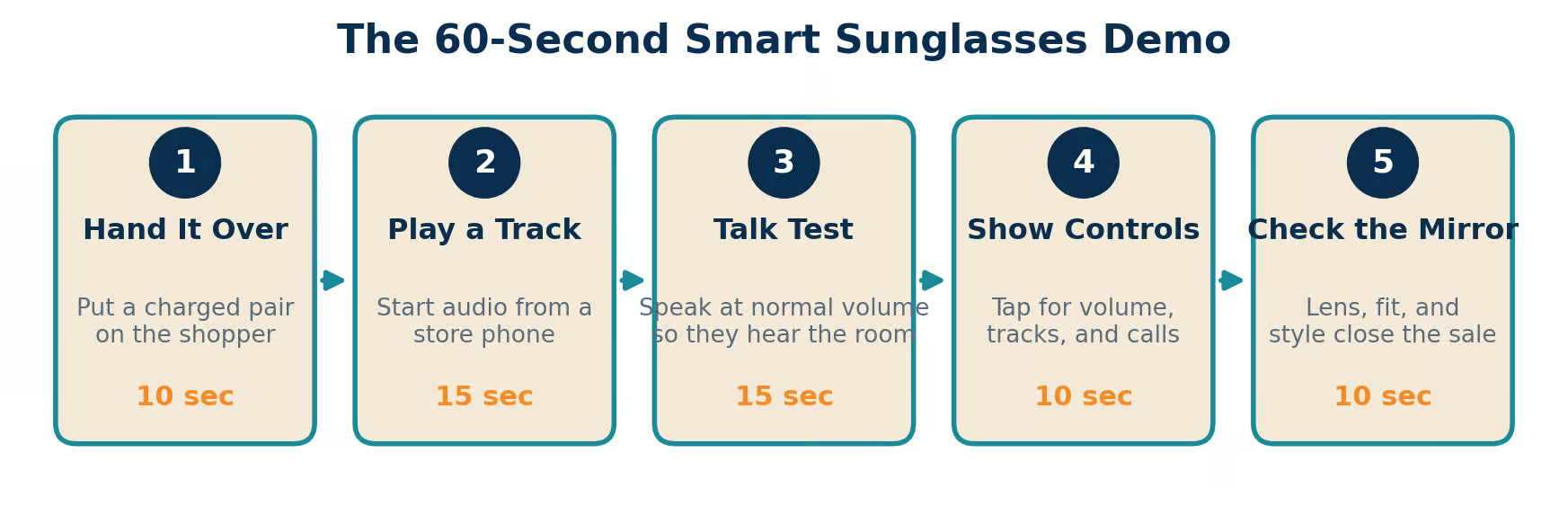
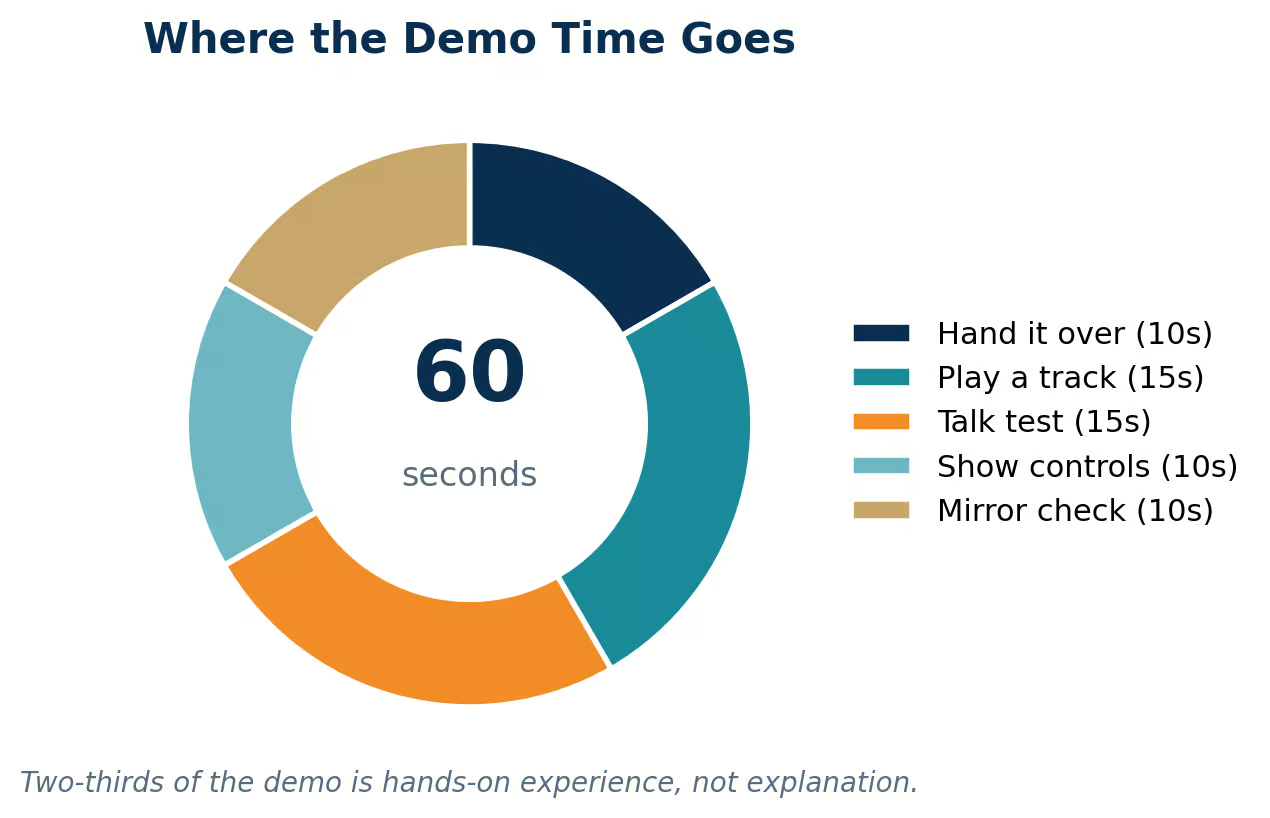
Staff do not need a script, but they do need a routine. The routine below takes about a minute, and most of that minute is the shopper experiencing the product rather than listening to a pitch.
 A five-step demo routine staff can learn in one shift.
Step 1: Hand It Over
Put the charged demo pair directly in the shopper's hands and let them put it on. Ownership starts the moment the product is on their face.
Step 2: Play a Track
Start a song from the store device at a moderate volume. The first reaction is usually surprise at how clearly the audio comes through without anything in their ears.
Step 3: The Talk Test
While the music plays, speak to the shopper at a normal volume. When they realize they can hear you and the music at the same time, they understand the open-ear benefit instantly. This is the moment that sells commuters, walkers, and cyclists.
Step 4: Show the Controls
Our
Smart Sunglasses use touch controls on the frame for volume, track changes, and answering calls, with a built-in microphone for conversations. Have the shopper tap once themselves rather than watching you do it.
Step 5: Check the Mirror
Finish where every sunglass sale finishes: the mirror. Once the audio question is answered, the shopper decides on the same terms as any other pair. Do they like the look? Does it fit? Offering more than one frame color at this step helps close.
Keep explanation short. Let the product do the talking.
Four Answers Every Staff Member Should Know
Shoppers ask the same handful of questions about audio sunglasses. Staff who can answer them in one or two sentences sound confident, and confidence sells.
| Shopper Question |
Short Staff Answer |
| Will it work with my phone? |
Yes. It pairs over Bluetooth with both iPhone and Android. |
| Can people around me hear it? |
At normal volume the sound stays close to your ears. Turn it way up and people nearby may hear some of it. |
| Do they still protect my eyes? |
Yes. The lenses are sunglass lenses first. The audio is an added feature, not a tradeoff. |
| How do I charge it? |
It has a rechargeable battery. Charge it like your earbuds and you are ready to go. |
If a shopper asks a technical question staff cannot answer, the honest response is the best one: "Let me check for you." A wrong answer at the counter becomes a return later, and our article on
reducing sunglass return rates explains why setting accurate expectations at purchase protects margin.
Position the Category for the Holidays
The timing matters. Fall is already a stronger sunglasses season than most retailers expect, and the weeks ahead lead straight into holiday gift shopping. Smart sunglasses fit the gift conversation unusually well because they solve the classic gift problem: finding something that feels new for the person who already has everything.
- Frame it as a gift for a type of person. "For the runner," "for the commuter," and "for the dad who is always on a call" are faster to understand than a feature list.
- Keep a unisex mindset. The frame design and color options work across shoppers, which makes the category easy to recommend without guessing the recipient's style.
- Pair it with your gift assortment. Our guide to building a holiday gift sunglasses assortment covers how to group gift-friendly styles so shoppers see them together.
- Demo during peak hours. The busiest gift weekends are when the demo pair earns its keep. Make sure it is charged and a staff member owns the station.
Track What Is Working
Because smart sunglasses started as a test category, track them separately from the rest of your sunglasses sales. A simple tally at the register can tell you a great deal:
- How many demos did staff give this week?
- How many demos turned into a sale?
- Which color sold first?
- Were the buyers shopping for themselves or buying a gift?
If your demo-to-sale rate is healthy, reorder with confidence and consider adding color depth. If demos are low, the fix is usually placement or staff comfort, not the product. Move the station closer to the register and walk every staff member through the 60-second routine once.
Frequently Asked Questions
Do I really need to give up a unit as a demo pair?
Yes. A single demo pair is the most effective sales tool for this category. Without it, shoppers have no way to experience the audio feature, and most will not buy a feature they cannot test.
Should staff pair the shopper's own phone?
A store device is usually better. It is faster, avoids privacy hesitation, and keeps the demo consistent. If a shopper specifically wants to test with their own phone, it is fine to help.
Where should smart sunglasses go if I do not have counter space?
Choose a spot where staff pass frequently, such as near fitting mirrors or an electronics accessory rack, and add a clear sign inviting shoppers to ask for a demo.
Do smart sunglasses fit a surf, gift, or resort store?
Yes. Any store with commuters, walkers, beachgoers, or gift shoppers has a natural audience. The demo routine works the same way in every store type.
How do I know if the category is working?
Track demos and demo conversions separately from other sunglasses sales. Those two numbers tell you more than total units sold.
| Ready to Put Smart Sunglasses in Front of Your Shoppers?
Call West Coast Sunglasses at 727-530-9260 or toll free at 866-228-3888 to add Smart Sunglasses to your next order, or contact our wholesale team online. Our team can help you choose colors and quantities for a strong holiday season. |

 A five-step demo routine staff can learn in one shift.
 Keep explanation short. Let the product do the talking.



 No products in the cart.